Example Sportsbook App: NXTPlay
A working reference application that demonstrates how to build a complete alternative-sports betting experience on top of the ALT Sports Data API.
Example Sportsbook App: NXTPlay
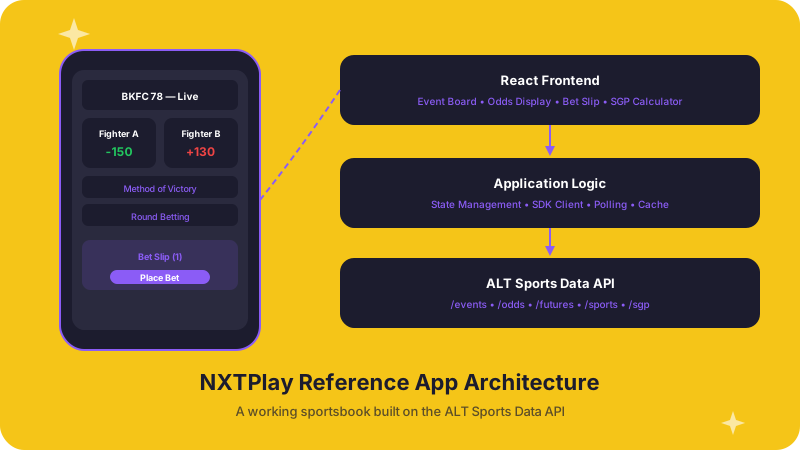
NXTPlay is a fully functional example sportsbook application built on the ALT Sports Data API. It exists to show — not just describe — how the API's sports, events, odds, and futures data come together into a cohesive product that a real bettor could use.
Whether you are an engineering team starting a new integration, a product manager scoping features, or a designer thinking through user flows, NXTPlay gives you a concrete reference point for what is possible and how the pieces fit.
What NXTPlay demonstrates
Sport and event discovery
NXTPlay uses the /sports endpoint to build a top-level navigation menu that lets users browse all available alternative sports. From there, the /events endpoint populates live and upcoming event boards, sorted by start time and filterable by sport. The result is a clean lobby experience where a user can go from "what's on?" to a specific event in two taps.
Market and odds display
Each event page in NXTPlay pulls odds data to show the available betting markets — moneylines, spreads, totals, props, and any sport-specific market types. The display updates on a regular polling cycle so users always see current pricing. Markets are clearly labeled with their status (open, suspended, closed) so users know what is actionable.
Futures shelves
NXTPlay includes a dedicated futures section that uses the futures endpoints to display longer-horizon bets — season winners, tournament champions, and similar outrights. This demonstrates that the API supports not just live event betting but also the forward-looking markets that drive engagement between event days.
Live event experience
For events currently in progress, NXTPlay surfaces live status updates, in-play odds movement, and real-time score or result data. This view shows how to combine the events and odds endpoints into a live-betting experience where the interface responds to the pace of the action.
Historical data and results
NXTPlay includes a results archive that pulls completed event data, letting users review past outcomes, check settlement details, and browse historical performance. This is a practical demonstration of how the same API that powers your live product also supports post-event features like stats pages, bet history, and trend analysis.
The API building blocks behind NXTPlay
| Feature | Primary endpoints |
|---|---|
| Sport navigation | /sports |
| Event boards | /events (filtered by sport, status, date range) |
| Market pricing | Event-level odds views |
| Futures | /futures |
| Results archive | /events (filtered by completed status) |
| Participant details | /players, event-level participant data |
Each of these maps directly to the API Reference, so you can trace any feature in NXTPlay back to the exact endpoint and payload that powers it.
Why NXTPlay matters for your build
NXTPlay is not a toy demo — it is a product-complete reference that solves the same problems you will encounter in production:
- Data freshness. NXTPlay's polling and refresh logic shows a practical approach to keeping boards and odds current without over-fetching.
- State management. The app manages event lifecycle transitions (upcoming, live, completed) in a way that keeps the UI coherent as events progress.
- Multi-sport architecture. NXTPlay handles sports with very different structures (team-based, individual, bracket, round-robin) through a single flexible UI framework.
- Graceful degradation. When data is unavailable or a market is suspended, NXTPlay shows how to handle those states without breaking the page.
Get started
Explore NXTPlay alongside the ALT Sports Data API documentation to see how each endpoint translates into a user-facing feature. If you are starting a new integration, NXTPlay is the fastest way to understand what the finished product can look like.
Further reading
- Use Cases — additional product patterns and integration scenarios.
- Money, Betting Lines, and Markets — deeper explanation of how odds and markets work in the API.
- Integration Setup — step-by-step guide for connecting to the ALT Sports Data API.
- Daily Processes and Reconciliations — operational playbook for handling the data changes NXTPlay handles automatically.