Working with /sports
Use the sports endpoints to discover supported sports, archetypes, and market coverage on the ALT Sports Data platform.
Working with /sports
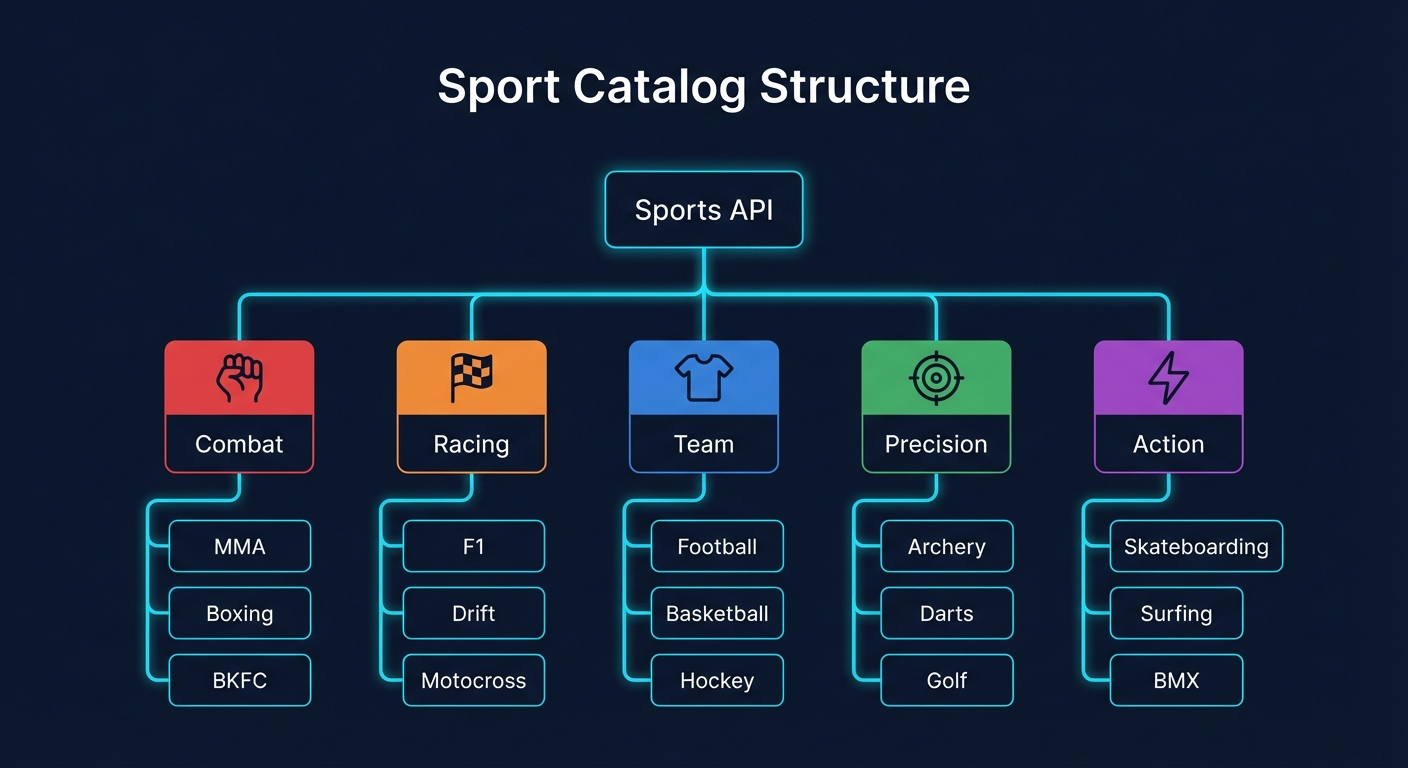
The /sports endpoint is the discovery layer for your integration. Call it
first to understand what is available on the platform before you build event
boards, widgets, or automated pipelines.
What it tells you
- Supported sports -- The full list of sports currently active on the platform, along with their identifiers.
- Archetypes -- Each sport maps to an archetype (e.g., combat, motorsport, team-vs-team, race) that determines its market families, participant structures, and settlement rules.
- Market availability -- Which market types are offered for each sport, so you know what you can display or trade against.
Why this matters
Alternative sports do not share a single market model. A combat sport has moneyline and round-betting markets. A motorsport has outright winner, top-N finish, and head-to-head matchups. A team sport might offer spreads and totals.
If you hard-code market assumptions, your integration will break the first time
you add a new sport. Instead, use /sports as the source of truth for what can
be shown, requested, or modeled downstream. Let the archetype drive your UI
layout and your trading logic.
Practical tips
- Cache the response -- The sports catalog changes infrequently. Fetch it on startup or once per day, and refresh on demand when you detect a new sport in an event response.
- Key off the archetype -- Build your display templates and market renderers around archetypes, not individual sports. This way, when a new sport launches under an existing archetype, your UI handles it automatically.
- Check market availability -- Before building a futures page or parlay builder for a sport, confirm that the relevant market families are listed in the sports response.